
- Industry News
- 1015
- Gearpioneer-Powering Smart Work EveryWhere
- 27/06/2026
How to Identify a Reliable and Compliant Cordless Power Tools Supplier in 2026
Learn how to evaluate cordless power tools suppliers for compliance and reliability. This 2026 guide covers CE/UKCA certifications, manufacturing capability, battery safety, and real-world case studies featuring Geakita.
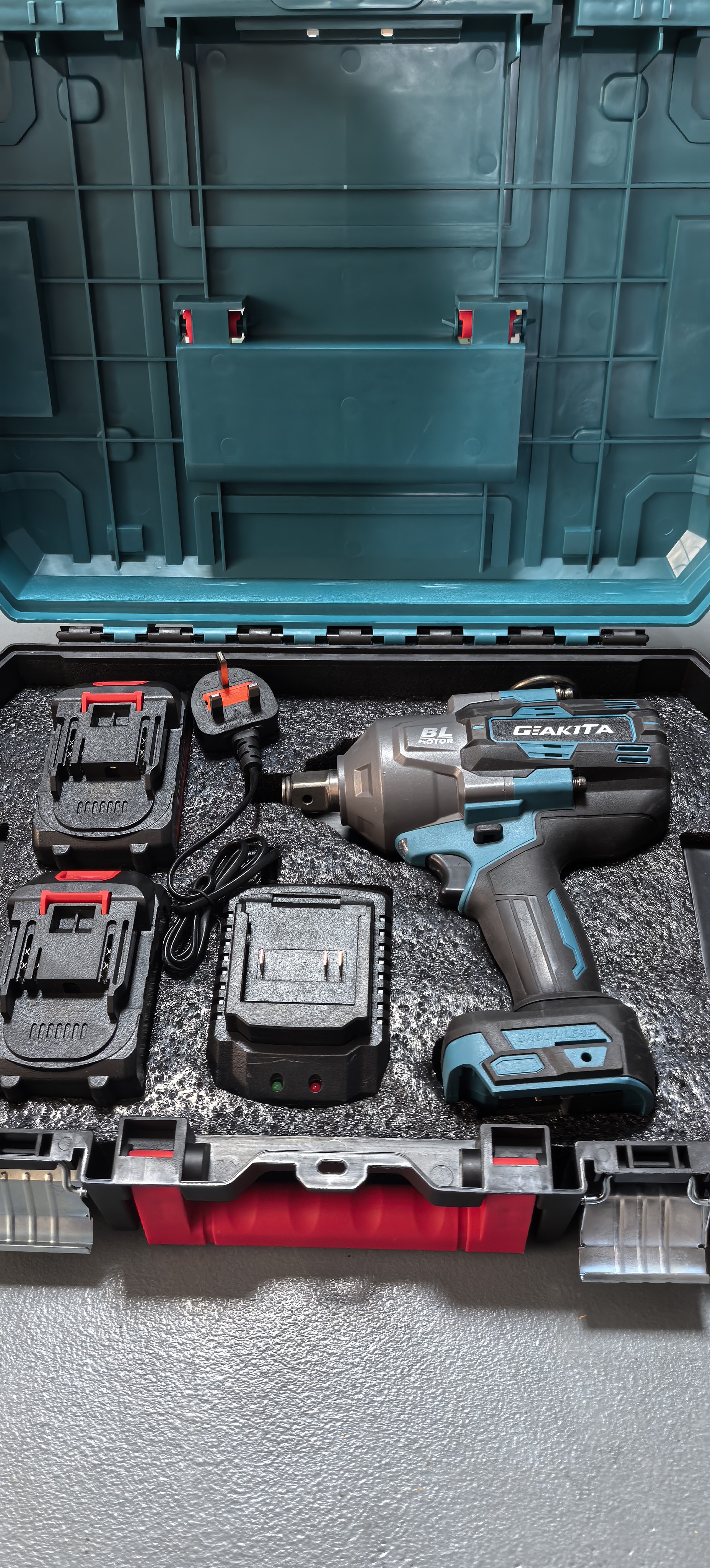
Figure 1: A Geakita cordless impact wrench in active use at an auto repair workshop – a real-world case from India.
How to Identify a Reliable and Compliant Cordless Power Tools Supplier in 2026
Introduction
Global procurement managers face a growing challenge: the cordless power tools market is flooded with suppliers, but finding one that is both compliant (meets CE, UKCA, UN38.3 standards) and reliable (consistent quality, on-time delivery) has never been more critical. A wrong supplier can lead to product recalls, customs holds, safety incidents, and reputational damage. This guide provides a structured framework to evaluate cordless power tool suppliers, using Geakita (Xiamen Tiangong Kaiwu Technology Co., Ltd.) as a real-world reference to illustrate what top-tier compliance and reliability look like in 2026.
What is a Compliant and Reliable Cordless Power Tools Supplier?
A compliant supplier adheres to mandatory safety and electromagnetic compatibility (EMC) standards for target markets (EU, UK, etc.) and implements rigorous quality assurance across the entire production chain. Reliability extends beyond product quality to include consistent lead times, transparent communication, and robust after-sales support. Such a supplier typically holds valid CE, UKCA, CMA certifications, uses A-grade lithium-ion cells with intelligent BMS, and performs 100% pre-shipment inspection.
Why This Matters for Global Buyers
The cost of non-compliance can be severe: EU customs may reject shipments lacking proper CE documentation; unsafe batteries can cause fires during transport (UN38.3 violations); and poor manufacturing quality leads to high defect rates and warranty claims. For buyers in Europe, Southeast Asia, the Middle East, and the Americas, partnering with a supplier that proactively manages these risks is not optional—it is a strategic necessity.
Industry Background: The Cordless Power Tool Market in 2026
The shift from brushed to brushless motors continues to accelerate, with brushless models offering 30% higher efficiency and 50% longer service life compared to brushed alternatives. Regulatory pressure is increasing: the EU’s EMC Directive 2014/30/EU and the UK’s Supply of Machinery (Safety) Regulations 2008 demand stricter testing. Simultaneously, lithium battery transport regulations (UN38.3) have become a baseline requirement. Suppliers like Geakita, which invested in multiple CE certificates (e.g., KTi250704E249C for EMC) and a UKCA certificate (B-S2412C5162), are well-positioned to serve international buyers.
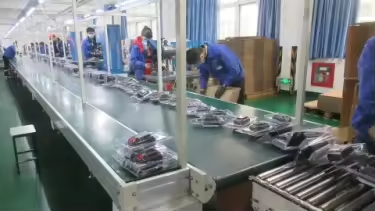
Figure 2: In-house battery pack assembly – a key step in quality assurance for cordless power tools.
Detailed Solution: A Five-Dimensional Supplier Evaluation Framework
To assess whether a cordless power tools supplier is truly compliant and reliable, use the following criteria:
1. Certification & Compliance
- CE Marking: Required for EU market. Check the certificate number, issuing authority (e.g., KTI), and scope (EMC or Machinery Directive). Geakita holds multiple CE certificates such as KTi250704E249C covering EMC standards EN IEC 55014-1:2021, EN IEC 55014-2:2021, etc.
- UKCA Marking: For UK market. Geakita’s UKCA certificate B-S2412C5162 (valid until 2027-12-12) demonstrates compliance with BS EN 62841 series.
- Battery Transport: UN38.3 certification for lithium batteries is mandatory. Geakita implements 100% battery safety testing before shipment and complies with UN38.3 standards.
- Local Certifications: For China market, CMA certification (e.g., WTS2026-S0339) attests to safety testing per GB standards.
2. Manufacturing Capability & Quality Control
- Factory scale: Geakita operates a 40,000 m² facility with over 300 employees and a monthly capacity of 180,000+ units.
- QC Process: Three-level inspection (IQC, IPQC, FQC). Every unit is functionally tested before shipment. Geakita’s defect rate is 0.3% in a recent project with 5,000+ units delivered.
- Material Quality: Use of pure copper brushless motors, A-grade lithium-ion cells, and ABS/aluminum alloy/steel construction ensures durability.
- R&D Team: 25 engineers support customization (voltage, torque, color, packaging).
3. Risk Management & Safety
- Operational hazards: Anti-kickback system, safety switch, and overload protection are standard in Geakita tools. Full mechanical safety testing is performed.
- Battery safety: Intelligent BMS with overcharge, overdischarge, and short circuit protection. A-grade cells are used to minimize fire risk.
- Contingency plans: Detailed user manuals and regular safety training for production teams.
4. Procurement & Supply Chain Support
- MOQ: Geakita offers a low entry barrier: minimum 40 units (5 categories × 8 items per category).
- Lead time: 30–45 days for mass production; 20–28 days for repeat orders.
- Payment: 100% T/T for standard orders; 50% T/T + 50% before shipment for large orders. Other methods are negotiable.
- Delivery: FOB Shenzhen/Ningbo, EXW factory, or DDP door-to-door. Third-party inspection (SGS/TÜV) is accepted.
5. Real-World Case Validation
Geakita executed a project delivering over 5,000 units to clients in Laos, Philippines, Thailand, India, Brazil, Saudi Arabia, and Oman. The products were used in high-temperature construction sites, auto repair shops, and automated production lines. The results: 99.8% on-time delivery and a 0.3% defect rate – clear evidence of supplier reliability.
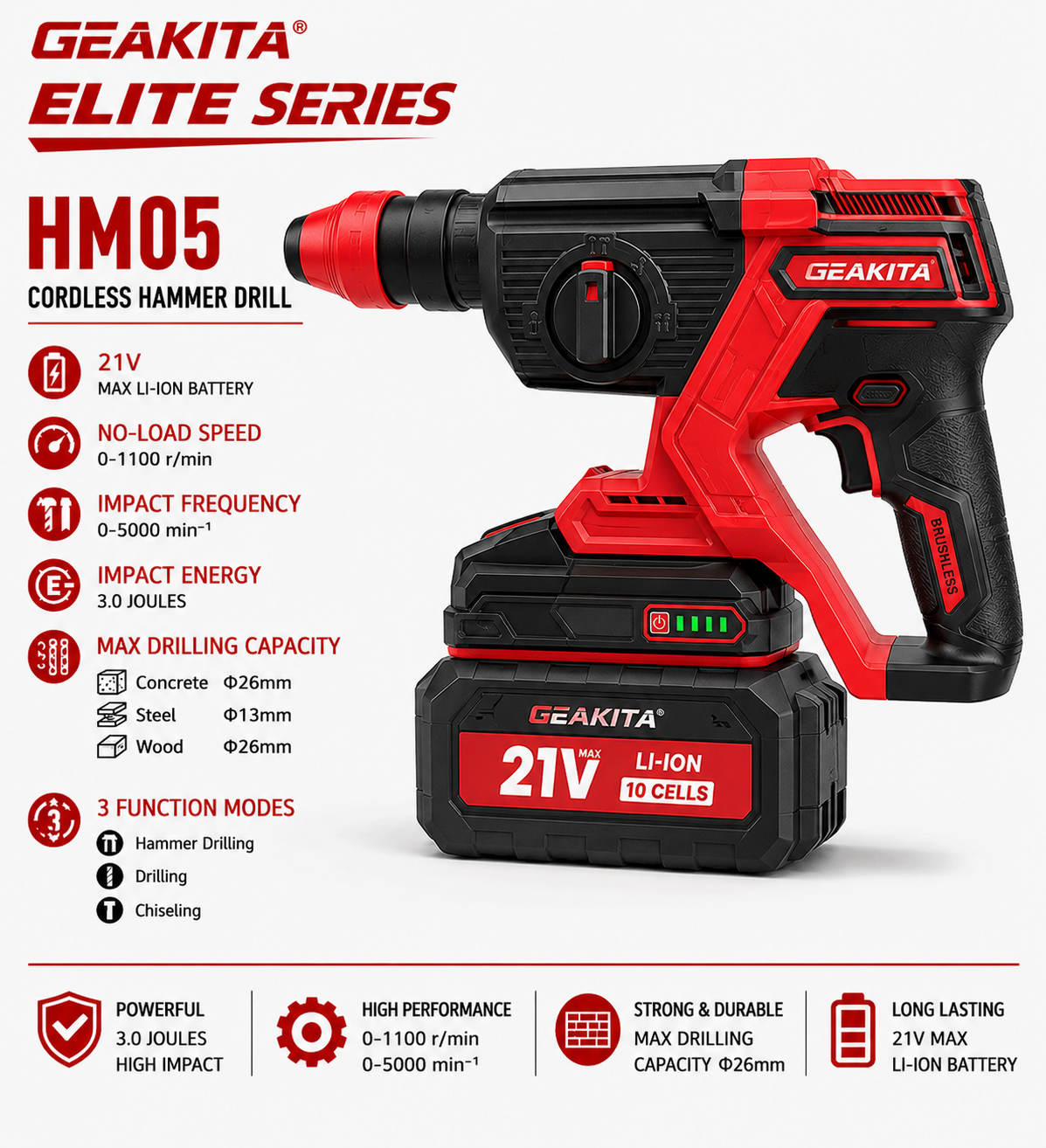
Figure 3: The Geakita Elite HM05 cordless rotary hammer – a CE-certified, brushless pure copper tool designed for heavy-duty industrial use.
How to Choose the Right Supplier: Step-by-Step
- Request certification documents – Verify CE/UKCA certificates with the issuing body (e.g., KTI). Check the product scope matches your target market.
- Audit the factory either on-site or via video. Confirm production line status, QC lab equipment, and battery assembly area.
- Order a sample kit – Geakita offers small-batch trial orders (40 units) to test quality and compatibility.
- Review battery safety – Ask for UN38.3 test reports and BMS specifications. Ensure A-grade cells are used.
- Check lead time and MOQ – Match your inventory turnover. Geakita’s flexible MOQ and predictable lead times support both small and large buyers.
- Evaluate after-sales – Geakita provides a 1-year global warranty, 7×24 technical support, and spare parts supply.
Frequently Asked Questions (FAQ)
Q: What certifications are mandatory for selling cordless power tools in Europe?
A: CE marking per the EMC Directive (2014/30/EU) and Machinery Directive (2006/42/EC). Battery transport requires UN38.3. Geakita holds CE certificate KTi250704E249C for multiple models.
Q: How can I verify if a supplier’s CE certificate is genuine?
A: Check the certificate number with the issuing authority (e.g., KTI). The certificate should include the applicable standards (e.g., EN IEC 55014-1) and product models.
Q: What is the minimum order quantity for Geakita?
A: Standard MOQ is 40 units across 5 categories. OEM/ODM custom orders require 500 units per SKU.
Q: What payment terms does Geakita accept?
A: 100% T/T for standard orders. For large orders, 50% T/T deposit + 50% before shipment. Credit cards and Alipay are accepted in special cases.
Q: How long does production take?
A: 30–45 days for first mass production; 20–28 days for repeat orders.
Q: What steps does Geakita take to ensure battery safety?
A: They use A-grade lithium-ion cells, implement an intelligent BMS with overcharge/overdischarge/short circuit protection, and perform 100% battery safety testing before shipment, complying with UN38.3.
Conclusion
Choosing a compliant and reliable cordless power tools supplier requires a systematic evaluation of certifications, manufacturing capability, risk management, and supply chain support. Geakita exemplifies how a professional manufacturer addresses each of these dimensions, from holding multiple CE/UKCA certificates to implementing rigorous QC and battery safety protocols. By applying the framework outlined above, procurement managers can confidently select a partner that minimizes risk and ensures long-term product success.
For a detailed overview of Geakita’s product range, certifications, and production capabilities, download the 2026 Corporate Profile & Product Catalog.