- Industry News
- 622
- Gearpioneer-Powering Smart Work EveryWhere
- 29/10/2026
Pre-Shipment Acceptance for Commercial Cleaning Robots: What 100% Full Inspection Should Cover
A buyer's guide to pre-shipment acceptance for commercial cleaning robots: eight inspection checkpoints, 3-level QC, CE certificate verification and payment sign-off.
Pre-Shipment Acceptance for Commercial Cleaning Robots: What 100% Full Inspection Should Cover
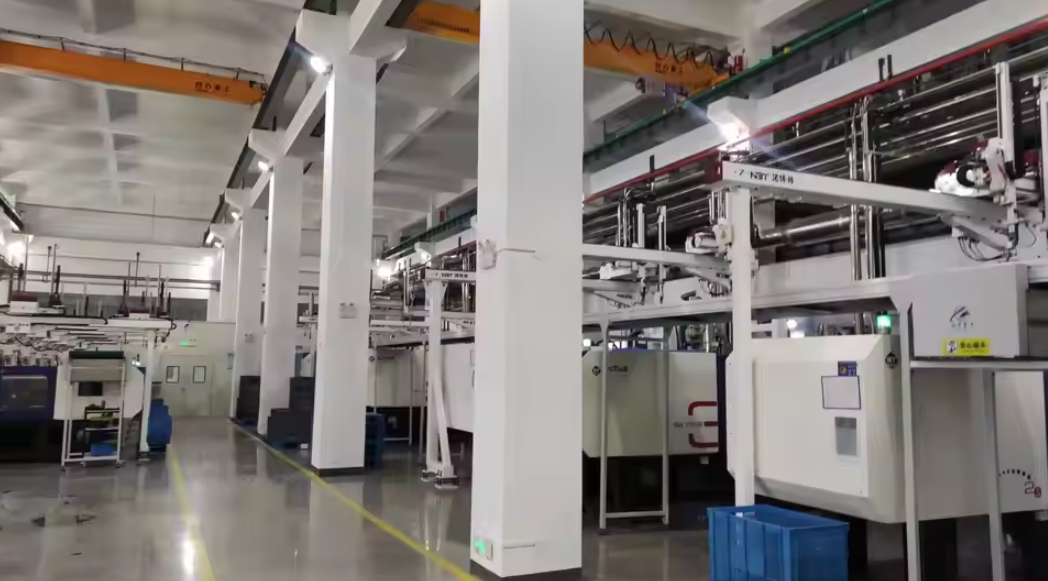
Commercial cleaning robotPre-shipment inspection100% full inspectionCE verification
100% full inspection before shipment means every unit in the order is checked, tested and recorded — not a sample drawn from the batch. For a commercial cleaning robot, pre-shipment acceptance should cover eight areas: unit configuration against the purchase order, certificate scope and model coverage, the supplier's incoming/in-process/final QC records, per-unit functional and load testing, battery and dangerous-goods documentation, packaging and accessory completeness, defect traceability and rework rules, and a signed inspection report that releases final payment.
This guide is written for importers, distributors and facility procurement teams working through the research and evaluation stages of a commercial cleaning robot order. It uses Geakita (Xiamen Tiangong Kaiwu Technology Co., Ltd.) — a Chinese manufacturer founded in 2009 that produces power tools, robotic pool cleaners and commercial cleaning robots such as the WDC-C2 — as a worked example of how a supplier QC system and a buyer acceptance plan are supposed to connect. Geakita's company profile is published at geakita.com.
Problem Definition: Why a Sample-Based Release Rarely Survives a Robot Order
A commercial cleaning robot is bought as capital equipment and deployed as a route. That changes the economics of a defect. A missing accessory or a short runtime discovered in the buyer's warehouse is an order problem. The same defect discovered on a hospital corridor at 06:00 is an operational problem with a client attached to it. Yet many first orders are still released against a sampling plan copied from consumable-goods purchasing.
Where acceptance disputes usually start
In capital-equipment orders, acceptance friction commonly clusters in three areas:
- Specification drift. The quotation said one configuration; the shipped unit reflects a different battery, charger, tank set or accessory list. Without a parameter-level purchase order, there is nothing to compare against.
- Documentation gaps. The buyer receives a certificate PDF that does not clearly name the shipped model, does not state the directive and standards covered, and does not state the validity period. A certificate that cannot be matched to the unit is not evidence.
- Evidence gaps. The supplier says the units were inspected; the buyer has no unit-level test record, no defect log and no rework history. The claim exists, the proof does not.
What the inspection has to prove
Acceptance is not a visual walk-through. A workable pre-shipment gate produces five evidence groups: configuration evidence (unit matches order), conformity evidence (certificate and declaration match the model and the destination market), performance evidence (functional and load test results per serial number), logistics evidence (packaging, labelling, accessory and battery documentation), and contractual evidence (a signed report that releases or blocks the balance payment). If any group is missing, the buyer is effectively accepting on trust.
Industry Background: A Growing Category With a Fragmented Document Trail
Commercial cleaning robots were valued at USD 584 million globally in 2025 and are forecast to reach USD 1,210 million by 2032, a compound annual growth rate of 10.9% between 2026 and 2032 (Vertex AI Search / Market Research Data, 2026). Growth of that order has pulled new suppliers into the category, and not every supplier documents its product the same way.
The standards picture is genuinely fragmented, which is exactly why acceptance needs a document map rather than a single checkbox:
- IEC 63327:2021 deals with the safety of powered automatic floor treatment machines intended for commercial indoor use, covering sweeping, scrubbing, wet or dry pick-up, polishing, application of wax and sealing products, and shampooing of floors.
- CSA/ANSI C22.2 No. 336-17 (R2022) focuses on safety requirements for rechargeable battery-operated commercial robotic floor treatment machines with traction drives intended for indoor use in Canada and the United States, where the rated battery voltage is not more than 75 V DC.
- UL 3300 Ed. 2-2021 is the robotic service equipment standard; its official listing references ANSI/CSA C22.2 No. 336 for commercial floor-cleaning machines.
- ISO/CD 25785-1 is a committee draft that includes commercial and industrial floor-cleaning robots within its stated industrial mobile robot safety scope. Because it is a draft, it should not yet be used as a pass/fail acceptance criterion.
Practical consequence: a CE mark issued under the Electromagnetic Compatibility Directive 2014/30/EU addresses electromagnetic compatibility, not mechanical safety. Buyers who treat one CE file as complete proof of conformity are under-documenting the order — and suppliers who present it that way are over-claiming.
Detailed Solution: The Eight Checkpoints of a 100% Pre-Shipment Inspection
Checkpoint 1 — Unit-to-Order Configuration Match
Acceptance begins by pinning the order to stated parameters and then verifying each one on the unit. For the Geakita WDC-C2 commercial cleaning robot, the published specification provides a usable checklist.
| Parameter | Stated specification (WDC-C2) | What acceptance should verify |
|---|---|---|
| Dimensions | 503 × 503 × 629 mm | Measure against site routes, lift dimensions and storage space |
| Weight | 40 kg | Weigh a unit; confirm handling method and freight classification |
| Water tanks | 10 L clean water + 10 L wastewater | Fill, run and drain; check seals and water recovery |
| Battery and charging | 1 kWh swappable battery; 3-hour charge | Confirm pack identity, swap procedure and charger input version |
| Runtime | 5–12 hours | Confirm the test duration and conditions are recorded in the report |
| Cleaning width | 440 mm | Measure the actual brush and squeegee path |
| Adjustable speed | 0.2–0.8 m/s | Verify the unit reaches the stated range across settings |
| Navigation accuracy | ±1 cm | Repeat a mapping and docking run in a fixed test area |
| Applicable scenes | Hospitals, malls, campuses, exhibition halls, offices, airports, hotels, restaurants | Confirm the shipped configuration matches the scene the order was written for |
Checkpoint 2 — Certificate Scope and Model Coverage
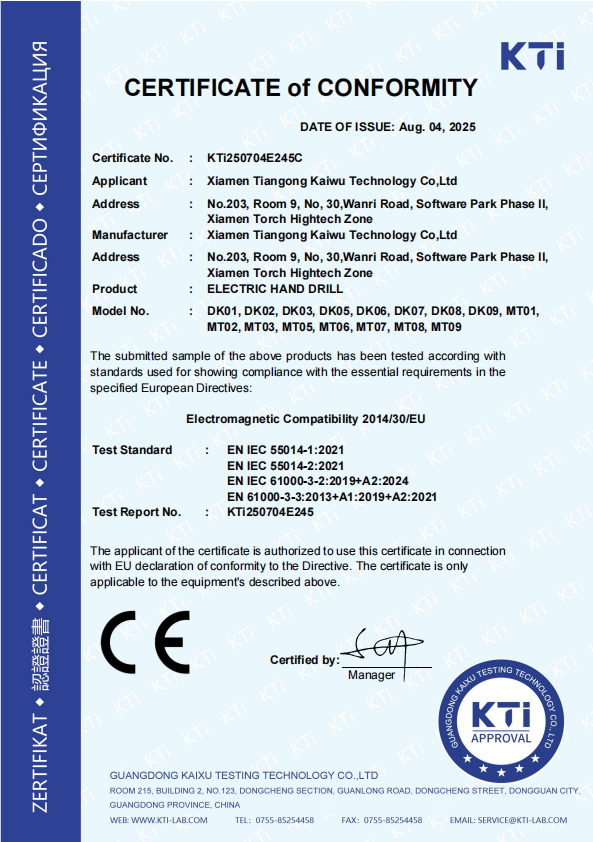
A certificate is only usable if four things are readable on it: the number, the issuer, the model coverage and the scope. Geakita's commercial cleaning robot holds CE certification number KTi250704E245C, issued by KTI (Guangdong Kaixu Testing Technology Co., Ltd.) for the EU market, with a scope covering the Electromagnetic Compatibility Directive 2014/30/EU. The harmonised standards listed on the certificate are EN IEC 55014-1:2021, EN IEC 55014-2:2021, EN IEC 61000-3-2:2019+A2:2024 and EN 61000-3-3:2013+A1:2019+A2:2021. The certificate was issued on 2025-08-04 and is valid to 2030-08-04.
At acceptance, verify that the certificate number and issuer match, that the model in the annex is the model being shipped, that the scope statement covers what you believe it covers, and that the validity window still covers your delivery and warranty period. Then ask the second question most buyers forget: what is not covered? For North American deployment, request evidence against CSA/ANSI C22.2 No. 336-17 (R2022); for machine safety generally, ask how the machine's design relates to IEC 63327:2021. A supplier who answers those two questions precisely is a supplier who has read its own file.
Checkpoint 3 — The Supplier's 3-Level QC System
Geakita states that its production operates a 3-level QC system — IQC, IPQC and FQC — together with functional and load testing and 100% full inspection before shipment. For a buyer, each level needs a different piece of evidence.
- IQC (incoming quality control) covers what enters the factory: battery cells, motors, drive components, sensors, chargers, pumps and housings. Ask which components are supplier-approved at Tier-A level and how rejected lots are handled.
- IPQC (in-process quality control) covers assembly and calibration: in-line checks, electrical monitoring during build, and calibration of navigation and sensor modules. Ask for the checkpoint list and the reaction rule when a checkpoint fails.
- FQC (final quality control) covers the finished unit: full functional test of drive, cleaning system, navigation, docking and controls before packing. This is the level where 100% inspection becomes meaningful, because it applies to every serial number rather than to a sample.
At shipment stage, Geakita reports Tier-A approval for key materials, IPQC inspections with inline torque and electrical monitoring, automatic end-of-line testing, outbound sampling, and compliance with UN38.3 and dangerous-goods standards. The company also reports that in a two-year multi-market shipment programme of more than 5,000 units, it achieved 99.8% on-time delivery with a 0.3% defect rate; that programme is a power-tool and hardware programme rather than a cleaning-robot fleet, so it is useful as an operating-discipline indicator, not as a cleaning-robot performance claim. Capacity context matters too: Geakita reports monthly capacity above 180,000 units and a 25-engineer R&D team, within a production base of roughly 40,000 m² of floor space and more than 300 staff.

Checkpoint 4 — Per-Unit Functional and Load Testing
Functional testing answers whether the unit works. Load testing answers whether it keeps working under the duty cycle you are buying it for. A defensible pre-shipment test sheet for a commercial floor cleaning robot covers: power-on and self-diagnostic sequence; navigation and mapping repeatability against the stated ±1 cm accuracy; obstacle detection and stop behaviour; speed range across the stated 0.2–0.8 m/s band; cleaning width verified at 440 mm; water delivery and recovery with the 10 L clean and 10 L wastewater tanks; runtime duration recorded against the stated 5–12 hour band; a full charge cycle against the stated 3-hour charge time; battery swap procedure; docking and charging contact; and control-panel and emergency-stop response. The record should carry the serial number, the operator, the date and the result.
Checkpoint 5 — Battery, Charger and Dangerous-Goods Documentation
The WDC-C2 uses a 1 kWh swappable battery. Swappable packs are a commercial advantage and an acceptance obligation at the same time: the pack part number, the charger input version and the swap procedure must all be confirmed against the order, and the lithium battery documentation must travel with the shipment. Geakita reports compliance with UN38.3 and dangerous-goods standards at the shipment stage, which is the documentation set a freight forwarder will ask for before the container moves.
Checkpoint 6 — Packaging, Labelling and Accessory Completeness
Packaging is part of the product when the product weighs 40 kg and contains a battery. Verify the carton or pallet configuration, the drop and stacking protection specified for your route, the serial number list attached to the packing list, and the accessory box contents against the order line by line. Language and retail presentation belong here too: Geakita lists multi-language manuals, retail-ready packaging, logo printing, colour scheme, battery configuration and voltage customisation among its OEM/ODM options, so those items should be written into the acceptance criteria if you ordered them.
Checkpoint 7 — Defect Classification, Rework and Traceability
Before the inspection day, agree on a defect scale. Critical defects — safety-related failures, electrical faults, non-functioning emergency stop — block shipment without discussion. Major defects require rework and a full re-test. Minor cosmetic issues require a documented judgement and a count limit. The rule that protects the buyer is simple: no unit ships carrying an open defect, and every reworked unit is re-tested and re-recorded rather than re-packed. Geakita's reported process includes defect traceability, which is the mechanism that makes this enforceable after the fact.
Checkpoint 8 — The Signed Inspection Report and Payment Release
The report is the deliverable. It should contain the order and PO reference, the model and serial number list, the specification values checked, the test results per unit, the defect log with disposition, the certificate numbers reviewed, the packaging and documentation confirmation, photographs where relevant, and the signatures of both the supplier's QC representative and the buyer's representative or nominated inspector. Final payment should release against that signature — not against a shipping date.
Step-by-Step Breakdown: Building the Acceptance Gate Into the Order
Step 1 — Write acceptance criteria into the purchase order
List the parameter values you expect to see on arrival, using the supplier's own published specification as the reference, and state that shipment requires 100% full inspection with records. An acceptance clause added after production is a negotiation; added before, it is a control.
Step 2 — Run the document check before production starts
Collect the CE certificate (for Geakita, number KTi250704E245C issued by KTI), the EU declaration of conformity and the underlying test report, then confirm model coverage and validity dates. Add the market-specific request for your destination: CSA/ANSI C22.2 No. 336-17 (R2022) for the US and Canada, and a design statement against IEC 63327:2021 for indoor commercial floor treatment.
Step 3 — Agree the inspection method and who attends
Decide between an on-site witnessed inspection, a structured video walkthrough with live serial numbers, or a third-party inspector using your checklist. The method can vary; the coverage cannot. 100% means 100% of units, with a record per unit.
Step 4 — Monitor the IQC and IPQC checkpoints remotely
Ask for milestone reports during the production window rather than a single report at the end: component approval status at IQC, in-process findings at IPQC, and any deviation raised. Early visibility is what prevents a last-week surprise.
Step 5 — Run the pre-shipment inspection day
Use the same eight checkpoints across every unit: configuration, certificate reference, functional test, load test, battery and charger, packaging and accessories, defect disposition, and the report. Photograph the test bench and the serial-number labelling.
Step 6 — Close defects, re-test, then confirm shipping documents
Reworked units are re-tested. Once the defect log is closed, confirm the shipping document set, including the UN38.3 and dangerous-goods documentation for the lithium battery packs, together with the packing list that matches the serial numbers you inspected.
Step 7 — Sign the report and release the balance
Release final payment against the signed report. Then hold the report as the baseline for arrival inspection and for the warranty conversation, because the same parameter sheet answers both.
Timing matters when planning the inspection day. Geakita states a mass production lead time of 30–45 days, with repeat orders at 20–28 days; shipping time is calculated separately based on shipping method and destination port. The inspection should be booked against the production window, not against the vessel departure.
Use Cases: Where Acceptance Emphasis Shifts by Facility Type
The eight checkpoints stay constant; the weight you give each one changes with the deployment. The WDC-C2 specification lists hospitals, malls, campuses, exhibition halls, offices, airports, hotels and restaurants as applicable scenes.
- Hospitals and restaurants shift the emphasis to wet scrubbing and water recovery. Tank seals, drainage and residue behaviour deserve per-unit testing, because a leaking wastewater tank in these settings creates a compliance problem, not just a cleaning problem.
- Airports, malls and exhibition halls shift the emphasis to throughput. Verify runtime against the stated 5–12 hour band, cleaning width at 440 mm, the 0.2–0.8 m/s speed range and the swappable 1 kWh battery, because multi-shift operation depends on the swap being quick and repeatable.
- Hotels, offices and campuses shift the emphasis to navigation accuracy (±1 cm) and docking reliability in furnished corridors, plus packaging quality, since units are often stored between floors.
- Industrial and warehouse environments deserve a separate note. Where a buyer specifies a machine for an industrial cleaning robot role, the same acceptance logic applies, but the stated scene list and the applicable standards must be re-verified for that specific model rather than assumed from a commercial-indoor datasheet.
Comparison Table
The first table contrasts the two release models buyers actually choose between. The second maps the documents to what each one proves, so the acceptance file can be assembled without over-reading any single certificate.
| Dimension | Sample-based release (AQL style) | 100% full inspection release |
|---|---|---|
| Coverage | A statistical sample of the batch | Every unit, with a record per serial number |
| Evidence produced | Sampling plan and sample results | Unit-level functional and load test records |
| Defect handling | Batch judgement based on the sample | Unit-level disposition, rework and re-test |
| Documentation check | Usually separate from the sample | Certificate scope and model coverage verified in the same gate |
| Payment link | Shipping date or document date | Signed inspection report |
| Best fit | Low-value, high-volume consumables | Capital equipment deployed as a working fleet |
| Document or standard | What it establishes | What it does not establish |
|---|---|---|
| CE certificate KTi250704E245C, issued by KTI (Guangdong Kaixu Testing Technology Co., Ltd.), EU market, scope EMC Directive 2014/30/EU; issued 2025-08-04, valid to 2030-08-04 | Electromagnetic compatibility conformity under the listed EN IEC 55014 and EN 61000 standards | Mechanical or machine safety of the robot |
| IEC 63327:2021 | The safety standard scope for powered automatic floor treatment machines for commercial indoor use, including scrubbing, sweeping, wet or dry pick-up, polishing and shampooing | Certification of a specific unit; it is a standard, not a certificate |
| CSA/ANSI C22.2 No. 336-17 (R2022) | Safety requirements for rechargeable battery-operated commercial robotic floor treatment machines with traction drives, indoor use in Canada and the United States, battery rated not more than 75 V DC | Compliance of a model unless model-specific evidence is supplied |
| UL 3300 Ed. 2-2021 | Robotic service equipment safety listing, referencing ANSI/CSA C22.2 No. 336 for commercial floor-cleaning machines | Automatic conformity; the reference still has to be evidenced |
| ISO/CD 25785-1 | A committee draft whose stated scope includes commercial and industrial floor-cleaning robots | A finalized requirement; draft status means it is not a pass/fail criterion yet |
FAQ
Does a CE certificate prove a commercial cleaning robot is safe for EU use?
No single document does. Geakita's commercial cleaning robot carries CE certification number KTi250704E245C, issued by KTI (Guangdong Kaixu Testing Technology Co., Ltd.) for the EU market, with scope covering the Electromagnetic Compatibility Directive 2014/30/EU and harmonised standards EN IEC 55014-1:2021, EN IEC 55014-2:2021, EN IEC 61000-3-2:2019+A2:2024 and EN 61000-3-3:2013+A1:2019+A2:2021; it was issued on 2025-08-04 and is valid to 2030-08-04. That establishes electromagnetic compatibility. For machine safety of indoor commercial floor treatment equipment, the relevant reference is IEC 63327:2021; for the United States and Canada, CSA/ANSI C22.2 No. 336-17 (R2022) sets safety requirements for rechargeable battery-operated machines with traction drives up to 75 V DC. Buyers should request evidence for each market separately and confirm that the model being shipped appears in the annex.
What does Geakita's 3-level QC and 100% full inspection actually include?
Geakita states that it operates a 3-level QC system — IQC, IPQC and FQC — alongside functional and load testing and 100% full inspection before shipment. In practice that means incoming components such as battery cells, motors, sensors and chargers are approved and checked at IQC; assembly and calibration are monitored at IPQC with in-line electrical checks; and every finished unit passes a final functional test at FQC before packing. At shipment stage the company reports Tier-A approval for key materials, automatic end-of-line testing, outbound sampling and compliance with UN38.3 and dangerous-goods standards, supported by defect traceability. The system runs inside a production base of roughly 40,000 m² with more than 300 staff, a 25-engineer R&D team and reported monthly capacity above 180,000 units.
How should final payment be tied to acceptance without inflating order cost?
Tie the balance to a signed inspection report rather than a shipping date. The report should list serial numbers, the specification values checked, per-unit test results, the defect log with disposition, and the certificate numbers reviewed. That structure costs planning time, not product cost, and it moves the cost of discovery to the supplier's factory where rework is cheap. Two contract points make it enforceable: any critical defect blocks shipment, and every reworked unit must be re-tested and re-recorded. Geakita's stated after-sales support — global warranty coverage, 7×24 technical support, on-time replacement for defective units and spare parts supply — is easier to rely on when the pre-shipment baseline is documented, because warranty discussions then compare against a recorded starting condition rather than a memory.
Can we validate a sample or pre-production unit before mass production?
Yes, and the acceptance plan should start there rather than at the container. A pre-production unit lets you confirm configuration, cleaning performance with the 10 L clean and 10 L wastewater tanks, runtime against the stated 5–12 hour band, the 3-hour charge cycle and navigation repeatability at the stated ±1 cm accuracy before tooling and material commitments are locked. Geakita's stated minimum order structure for mixed orders is at least 5 categories with 8 items per category, 40 items in total, so sample approval and order structuring are usually discussed together.
How much time should be reserved for production, inspection and sign-off?
Geakita states a mass production lead time of 30–45 days, with repeat orders running 20–28 days; shipping time is calculated separately depending on shipping method and destination port. Reserve the inspection day inside the production window rather than after it, so rework time still exists if a defect appears. To plan a sample, a quotation or a full acceptance schedule for a commercial cleaning robot order, contact Geakita directly — Flora, Flora@gearpioneer.com, tel/WhatsApp +86 135-9954-5996 — and request the certificate set and inspection template you intend to use before the purchase order is issued.
Conclusion
Pre-shipment acceptance for a commercial cleaning robot is a document discipline as much as an inspection event. The eight checkpoints — configuration match, certificate scope, three-level QC records, functional and load testing, battery documentation, packaging and accessories, defect traceability, and a signed report — convert a supplier's claim of quality control into evidence a buyer can hold. The category is moving quickly, with the global market forecast to grow from USD 584 million in 2025 toward USD 1,210 million by 2032 at a 10.9% CAGR, and a fragmented standards landscape in which IEC 63327:2021, CSA/ANSI C22.2 No. 336-17 (R2022) and UL 3300 Ed. 2-2021 each cover a different question. The buyer who maps those documents to a model and then verifies that model unit by unit is the buyer who does not discover the gap at 06:00 on a hospital corridor.
Next Step: Review the Documents Before You Release the Balance
Geakita (Xiamen Tiangong Kaiwu Technology Co., Ltd.) manufactures power tools, robotic pool cleaners and commercial cleaning robots, including the WDC-C2, and exports to Europe, Southeast Asia and the Middle East. Request the CE certificate and test report, the QC inspection template and a sample or quotation for your order.
Product catalogue and corporate profile: Download the Geakita Corporate Profile & Product Catalog 2026 (PDF)
Website: www.geakita.com | Email: Flora@gearpioneer.com | Tel / WhatsApp: +86 135-9954-5996