- Industry News
- 404
- Gearpioneer-Powering Smart Work EveryWhere
- 15/06/2026
Commercial Cleaning Robot Compliance Guide
Learn which certifications are required for commercial cleaning robots (CE, UKCA, CMA, UN38.3) and how to verify supplier compliance. Includes a step-by-step guide and real-world case study for procurement managers.
Commercial Cleaning Robot Certifications: A Compliance Guide for Buyers
Introduction
Procuring a commercial cleaning robot for your facility—be it a hospital, hotel, airport, or warehouse—requires more than just evaluating technical specs. You must ensure that the robot meets all regulatory and safety standards for your target market. This guide answers the core buyer concern: What certifications are required, and how do you verify compliance? We leverage real-world certification data and quality protocols from Geakita (Xiamen Tiangong Kaiwu Technology Co., Ltd.), a leading Chinese OEM with over 300 employees and a 40,000 m² factory, to illustrate best practices.
Problem Definition
Buyers often face confusion when evaluating suppliers: Which certifications are mandatory for my country? How can I trust that the robot is safe and compliant? Without proper verification, you risk customs rejection, liability from accidents, and operational downtime. This article provides a structured approach to certification validation and compliance risk mitigation.
Industry Background
Commercial cleaning robots are subject to diverse regulatory frameworks globally:
- EU Market: CE marking (EMC Directive 2014/30/EU) is mandatory. The standard EN IEC 55014-1:2021 and EN IEC 55014-2:2021 apply to electromagnetic compatibility.
- UK Market: UKCA certification is required, referencing BS EN 62841-1:2015+A11:2022.
- China Market: CMA certification (GB 3883.1-2014) is needed for domestic sales.
- Global Battery Transport: UN38.3 certification ensures lithium batteries are safe for air/sea freight.
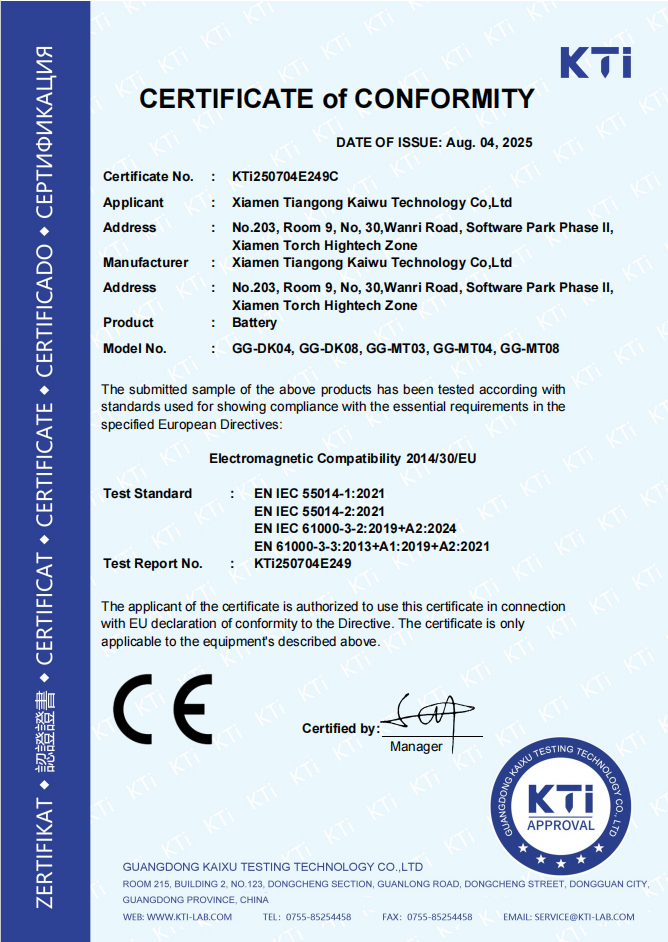
Geakita, founded in 2009, holds multiple active CE certificates (numbers KTi250704E245C, KTi250704E246C, etc.) issued by KTI, valid until 2030, covering both power tools and its commercial cleaning robot model WDC-C2.
Detailed Solution: How to Verify Compliance
Follow this six-step process to ensure your commercial cleaning robot supplier meets all certification requirements.
Step 1: Identify Target Market Requirements
Determine where the robot will be used. For EU countries, CE marking is required. For the UK, UKCA is needed (certificate number B-S2412C5162, issued by Beide Compliance Laboratory, valid until 2027-12-12). For China, look for CMA (certificate number WTS2026-S0339, issued by Zhejiang Zhongxie Lide Quality Testing Technology Co., Ltd.).
Step 2: Request Valid Certificates
Ask the supplier to provide copies of relevant certificates. Verify the certificate number, issuing authority, and expiry date. For example, Geakita's CE certificate for the WDC-C2 robot (certification number KTi250704E245C) was issued by KTI on 2025-08-04 and expires 2030-08-04, covering EN IEC 55014-1:2021, etc.
Step 3: Cross-Check Standards
Ensure the certificate references the correct standards for your application. For EU, the applicable standards include EN IEC 55014-1:2021 (emissions) and EN IEC 55014-2:2021 (immunity).
Step 4: Evaluate Quality Control Systems
Look for evidence of rigorous quality management. Geakita employs a 3-level QC process (IQC/IPQC/FQC), 100% full inspection before shipment, and inline torque/electrical monitoring. Their case studies demonstrate Tier-A material approval, 100% IQC sampling, defect traceability, and automatic EOL testing.
Step 5: Confirm Battery Safety Compliance
Lithium-ion batteries must comply with UN38.3 transportation standards. Geakita performs 100% battery safety testing before shipment and ensures full mechanical safety testing. The company also adheres to dangerous goods shipping regulations.
Step 6: Review Risk Control Measures
Operational safety risks—such as accidental injury from tool kickback or blade breakage—are addressed through anti-kickback systems, safety switches, and overload protection. Ask your supplier to document these features.
Use Case: European Hospital Procurement
A major hospital chain in Germany needed 50 commercial cleaning robots for its floors. The procurement team required:
- CE marking with valid EMC certificate
- UN38.3 compliance for battery transport
- Full mechanical safety test reports
They selected Geakita's WDC-C2 robot, which met all criteria. The supplier provided CE certificate KTi250704E245C, UN38.3 documentation, and a quality assurance report showing 0.3% defect rate in a similar project. The robots performed reliably with 5–12 hours runtime, 440mm cleaning width, and ±1 cm navigation accuracy.
| Parameter | Specification |
|---|---|
| Dimensions | 503 × 503 × 629 mm |
| Battery & Charging | 1 kWh swappable, 3h charge, 5–12h runtime |
| Cleaning Width | 440 mm |
| Navigation Accuracy | ±1 cm |
Frequently Asked Questions (FAQ)
Q: What CE standards apply to commercial cleaning robots?
A: The main standard is EN IEC 55014-1:2021 (electromagnetic compatibility – emissions) and EN IEC 55014-2:2021 (immunity).
Q: How long is a CE certificate valid?
A: Typically 5 years. Example: Geakita's CE certificate #KTi250704E245C is valid from 2025-08-04 to 2030-08-04.
Q: Can I use a CE certificate for the UK?
A: No. After Brexit, the UK requires UKCA certification. Geakita holds UKCA certificate #B-S2412C5162 valid until 2027-12-12.
Q: What is the difference between CE and CMA?
A: CE is for the European Economic Area; CMA is the Chinese mandatory certification based on GB standards.
Q: How do I verify a certificate is genuine?
A: Check the issuing authority (e.g., KTI, SGS, TÜV), the certificate number, and the expiry date. Request a digital copy with QR code if available.
Conclusion
Ensuring your commercial cleaning robot is properly certified is not just a regulatory formality—it protects your investment, your staff, and your reputation. By following the six-step verification process outlined above, you can confidently select a supplier that meets global compliance standards. Geakita, with its comprehensive CE, UKCA, and CMA certifications, combined with robust quality control and risk management, represents a reliable partner for buyers in Europe, the Middle East, and Southeast Asia. Contact Geakita today (Flora@gearpioneer.com, +86 135-9954-5996) to request certification documentation for your target market.
Disclaimer: Certification details are based on publicly available information and supplier documentation as of June 2026. Always verify current certificates directly with the manufacturer.