
- Industry News
- 774
- Gearpioneer-Powering Smart Work EveryWhere
- 17/06/2026
Balancing Cost & Quality in Commercial Cleaning Robot Sourcing
Learn how to balance quality and cost when sourcing commercial cleaning robots. Discover a 6-step TCO framework, brushless vs brushed motor comparison, and why Geakita is a trusted OEM partner.
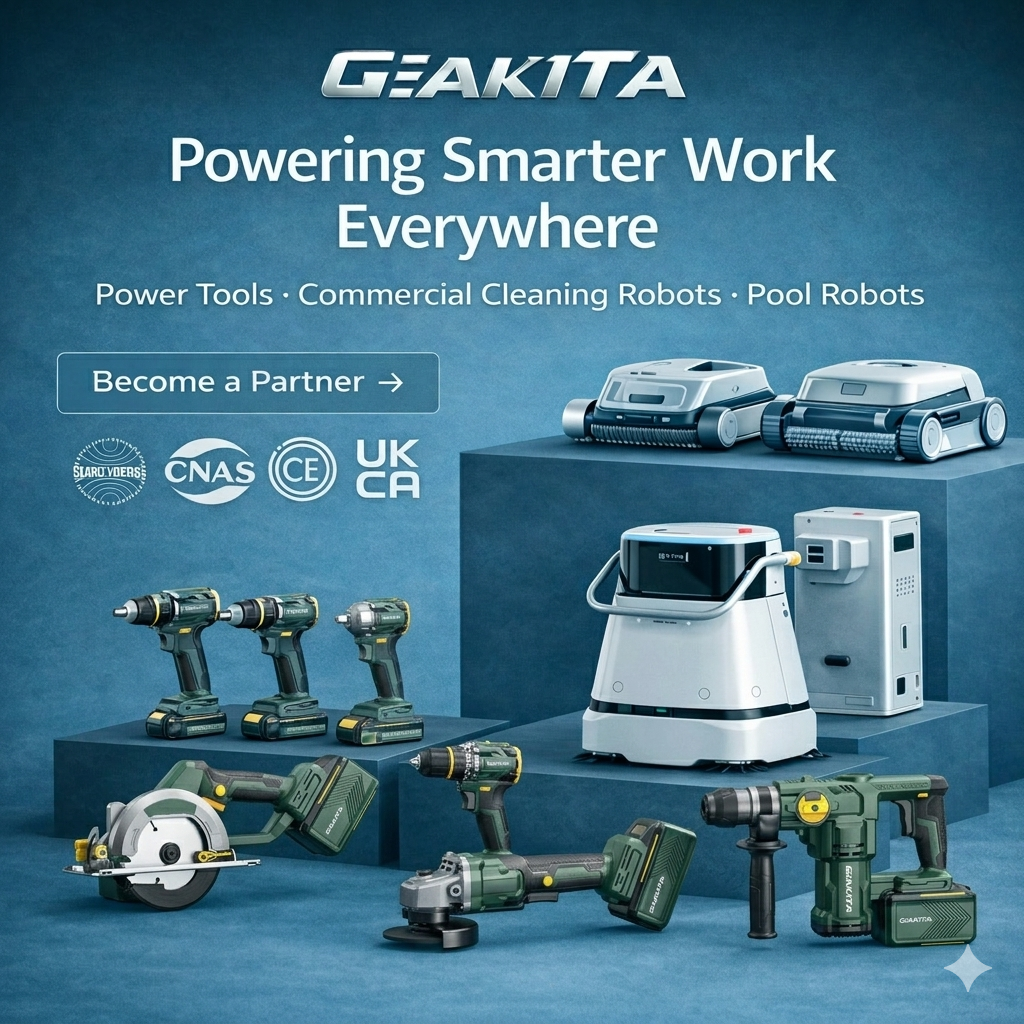
Geakita's integrated OEM/ODM platform enables buyers to reduce procurement costs without compromising on quality.
How to Control Costs Without Sacrificing Quality in Commercial Cleaning Robot Procurement
Introduction
Procurement managers across facility management, hospitality, healthcare, and retail chains face a critical dilemma: How to secure a commercial cleaning robot that delivers consistent cleaning performance while keeping upfront and long-term costs under control? The market is flooded with low-priced options, but hidden costs—frequent breakdowns, poor battery life, lack of certification, and inadequate after-sales support—quickly erode any initial savings. This guide provides a proven framework for balancing quality and cost when sourcing industrial cleaning robots, commercial floor cleaning robots, or warehouse cleaning robots.
Problem Definition
Buyers often ask: "How can I reduce the purchase price of a commercial scrubber dryer robot without ending up with a machine that fails on the job?" The core issue is that purchase price is only one component of total cost. A machine with a 20% lower sticker price may have a 50% higher defect rate, shorter battery cycle life, and expensive proprietary spare parts. The real cost control challenge lies in evaluating total cost of ownership (TCO)—including maintenance, energy consumption, downtime, and replacement frequency.
Industry Background
The global commercial cleaning robot market is expanding rapidly, driven by labor shortages and hygiene demands. In 2025–2026, hundreds of suppliers—from small workshops to large OEMs—compete for contracts. However, quality varies dramatically. Low-cost robots often use brushed motors (which wear faster), generic battery cells (prone to swelling), and lack critical certifications for global markets. Conversely, established manufacturers like Geakita (Xiamen Tiangong Kaiwu Technology Co., Ltd.) leverage over 16 years of power tool and robotics expertise to deliver hospital cleaning robots, hotel cleaning robots, and mall cleaning robots that meet CE, UKCA, and other compliance standards at competitive OEM prices. Founded in 2009 with a 40,000 m² factory and a team of 25 senior engineers, Geakita produces 100,000+ units annually across power tools, robotic pool cleaners, and commercial cleaning robots. Their annual export ratio of 20% to Europe, Southeast Asia, and the Middle East demonstrates their ability to meet diverse regulatory and quality requirements.
Detailed Solution: A 6-Step TCO-First Procurement Framework
The key to cost control is shifting from "lowest price" to "best value" through rigorous evaluation. Below is a step-by-step approach used by professional buyers.
Step 1: Define Application & Performance Requirements
Exact needs vary by setting. For an airport cleaning robot, navigation accuracy (±1 cm) and long runtime (5–12 hours) are critical. For a restaurant kitchen cleaning robot, oil resistance and compact size matter. Use a requirement matrix:
Clearly defined specs prevent over-specification (paying for unneeded features) and under-specification (leading to poor performance).
Step 2: Evaluate Motor & Battery Technology
Motor type directly impacts durability and TCO. Brushless motors last 50% longer and are 25% more energy-efficient than brushed alternatives. According to Geakita's comparison data, brushless motors deliver 30% higher working efficiency, 50% longer service life, and 20% longer battery runtime, with a defect rate of 0.5% versus 3–5% for low-cost brushed models. Over a 3-year period, the total cost of ownership is 10–15% lower due to reduced maintenance (no brush replacement) and fewer replacements. Insist on pure copper brushless motors and quality battery cells (A-grade lithium-ion with BMS protection).
Step 3: Verify Global Compliance Certifications
Non-compliant robots can be seized at customs, resulting in huge losses. For EU markets, confirm the supplier holds valid CE certification for EMC Directive 2014/30/EU (e.g., Geakita's CE number KTi250704E249C, valid until 2030). For the UK, check UKCA certification (e.g., Geakita's B-S2412C5162). For China, CMA certification (e.g., WTS2026-S0339) may be required. Request certificate numbers and verify with issuing bodies.
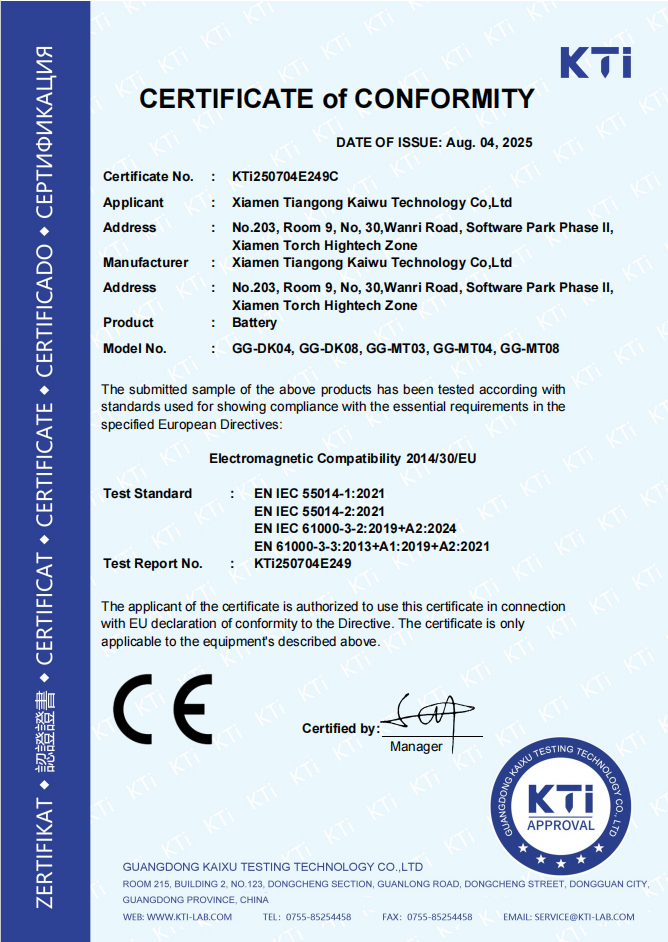
Geakita holds multiple CE certificates covering electromagnetic compatibility for its cleaning and power tool product lines.
Step 4: Assess Manufacturing Scale & Quality Control
Cost control through volume requires a supplier with consistent output. Geakita operates a 40,000 m² production base with over 300 employees, capable of an annual output of 100,000 units. Their quality system includes 100% full inspection before shipment, with IQC/IPQC/FQC three-level control, functional and load testing, and compliance with UN38.3 for battery transport. A factory with these capabilities can offer lower unit costs without sacrificing quality, thanks to process optimization and bulk material purchasing power.
Step 5: Compare Total Cost of Ownership (TCO)
Build a spreadsheet comparing not just purchase price but also: energy cost (brushless vs brushed), spare parts cost (filter, brushes, battery), labor cost for maintenance, and expected lifespan. Geakita's brushless platform typically requires 50% less maintenance, with a year global warranty and 7×24 technical support. For a robot used 8 hours daily, the 3-year TCO can be 15–20% lower than an equivalent brushed competitor.
Step 6: Negotiate Procurement Terms
With a shortlisted supplier like Geakita, negotiate MOQ, payment terms, and lead times. Geakita offers flexible MOQ—standard models start at 40 units for small-batch trial orders, and OEM/ODM requires around 500 units per SKU. Payment: 100% T/T for small orders, or 50% deposit + 50% at B/L for larger orders. Delivery options include FOB Shenzhen/Ningbo or DDP door-to-door. A phased rollout (trial → scale) reduces upfront risk.
Use Cases: How Different Facilities Benefit
- Hospital cleaning robot: In a 300-bed hospital, a reliable robot with ±1 cm navigation avoids collisions with equipment and patients. Geakita's WDC-C2 meets the noise and hygiene requirements. TCO savings come from reduced manual labor hours and lower maintenance.
- Supermarket cleaning robot: A large retail chain with 50 stores uses warehouse cleaning robots for back-of-house and commercial floor cleaning robots for sales floors. Standardizing on a single supplier (OEM) cuts per-unit cost by 12% through volume discount.
- Airport cleaning robot: Airports require 24/7 operation. Swappable battery (1 kWh) ensures continuous cleaning without recharging downtime. Geakita's 3-hour full charge and 5–12 hour runtime minimize battery stock investment.
Frequently Asked Questions
A: Check their factory size, years in business, client references, and certifications. A supplier with over 300 employees and 16 years of manufacturing experience, like Geakita, has proven stability. Request CE/UKCA certificates and a factory audit video.
A: For standard models, Geakita accepts 40 units for trial. For customized OEM (logo, packaging, voltage), MOQ is around 500 units per SKU. Smaller MOQ allows you to test the market before scaling.
A: Mass production lead time is typically 30–45 days, and repeat orders 20–28 days (shipping not included). Plan inventory accordingly.
A: Yes, Geakita accommodates third-party inspection upon request. They also offer 100% pre-shipment inspection by their own QC team and accept on-site acceptance at the factory.
A: Geakita provides a year global warranty, 7×24 technical support, on-time replacement for defective units, and spare parts supply. This reduces risk and long-term cost.
Conclusion
Controlling procurement cost for a commercial cleaning robot does not require compromising on quality. By adopting a TCO-focused framework, verifying motor technology, certification, and manufacturing capability, buyers can identify partners who deliver reliable performance at a competitive price. Geakita (www.geakita.com) exemplifies an OEM/ODM partner that balances quality and value, with a 40,000 m² factory, 300+ staff, annual output of 100,000 units, and comprehensive certifications for global markets. For inquiries including sample requests, technical specifications, or customized solutions, contact Flora at Flora@gearpioneer.com or via WhatsApp: +86 135-9954-5996. Take the first step toward smarter procurement today.